
Welcome back to your monthly Rough Drafts with Potential on:
The Tea: My mom got an infection and had to be in isolation for a few days, but she’s feeling better now. A Texas ice storm made me time travel through the last of January. I became an ACES member listed on their Editors for Hire board.
What I Watched: I watched a bunch of video game adaptations, including Fallout: Season 2, Return to Silent Hill, and Iron Lung. I also saw 28 Years Later: The Bone Temple, Send Help, and Whistle, and I finally got around to seeing Sorry, Baby. I rewatched Game of Thrones (and finished it just in time for A Knight of the Seven Kingdoms!) and the Lord of the Rings trilogy. You won’t believe it: I have thoughts.
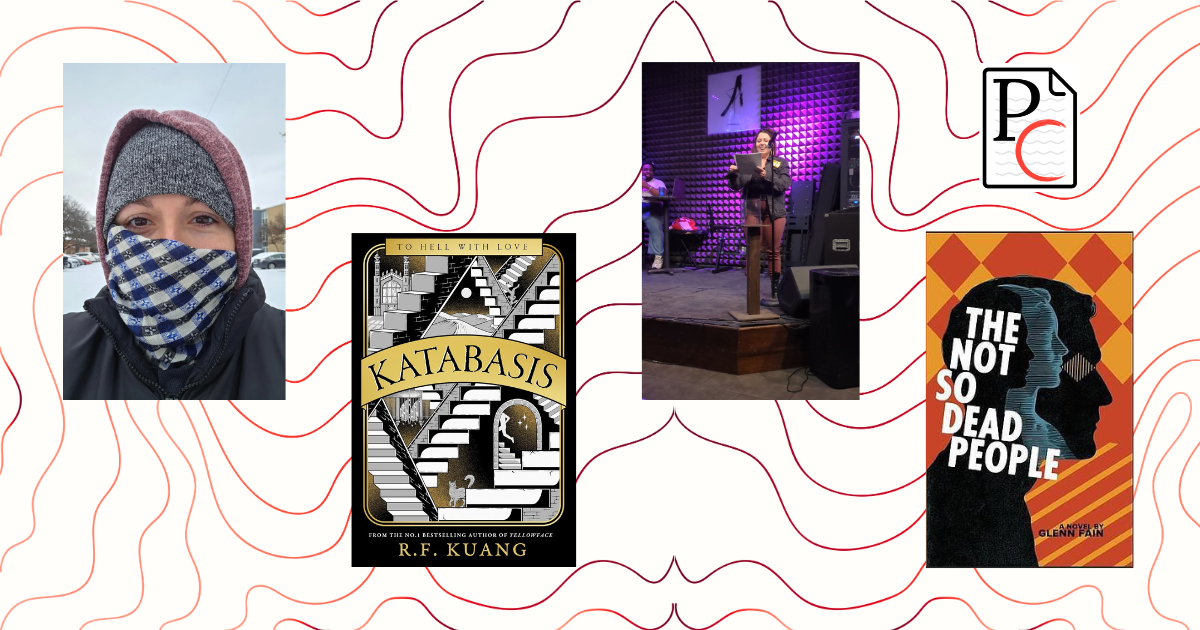
What I Read: I edited three manuscripts, read and reviewed another sci-fi advanced reader copy, and even—gasp!—read for pleasure. Katabasis by R.F. Kuang is a banger.
What I Worked On: I wrote two media reviews, a long-winded fangirl analysis of The Substance and a personal-ish essay on Biography of X. I performed a short personal essay for DSQO’s The Sex Files. I finished writing a personal essay and some poems, and I even shopped them around through Submittable!
Big Thoughts I Thought: Wait…am I writing a hybrid memoir?!
Jump around! Take what resonates and leave the rest.
The Tea of February 2026
My mom had to be isolated for a few days at her nursing facility because she got a serious, contagious infection, which meant she had to be on an IV drip of antibiotics. I had to mask- and gown-up when I visited her. She was very annoyed about being alone. She didn’t take her puzzle books or anything with her because she didn’t want to get germs on her stuff, which is fair. She’s out of isolation now and doing much better.
Once she had been reunited with her laptop, she found she couldn’t log in to her email account, and after an hour of being on the phone with her, we figured out that we needed to update her browser so that her password (which she did not remember and possibly has never known) could autofill.
Here’s a picture of my telling her to show me her screen with her phone, which I guess is my mistake, because most of the time this is what I saw:


An ice storm came through Texas in the last week of January and made me lose a fundamental understanding of time. I’m grateful that the power grid held up this year (I, and a number of others, have PTSD from the 2021 ice storm), so I was able to stay warm and enjoy my technological comforts. I got a terrible sinus infection right as the worst of the storm passed, which kept me indoors for an even longer period, and by the time I reemerged into the sunlight and its balmy 70-degree temperatures, I was completely feral and ungovernable.


Lastly, I became an ACES member, and I’m now listed on their Editors for Hire directory.
What I Watched Since I Last Posted
Video Game Adaptations
Who knew I was such a Gamer Gorl? My attitude about video games has changed dramatically since I conducted a short research study on Fallout 4 in 2015. Speaking of which:
Fallout: Season 2
I was late to the party, starting Prime’s Fallout series adaptation of the Fallout games about a year after it first came out. The first season was really more of a vibe check. Like, yes, this is what the game looks like. But although there were fun characters with driving motivations, I didn’t feel all that compelled by the plot. I watched each episode and felt just OK.
I actually liked season two, more than just OK, but less than “loved it.” Maybe it was that Maximus was more likeable, or that Lucy finally had some nuance. In other words, it took until season two to see the characters change. I had warmed to the story by the final episode, and I’m finally excited to see what happens next.
Maybe the series will be great by the time we get to season three. It’s so close.
Return to Silent Hill
To prepare for the newest Silent Hill adaptation, I watched my boyfriend play Silent Hill 2: Remastered and helped him solve the puzzles. (For the Silent Hill fans reading: We tried to play the original Silent Hill 2, but his Playstation 3 overheated, and we couldn’t get past the apartment building. I’m glad I could see a sliver of the original before playing the remastered version, so I could appreciate the differences and the callbacks to well-loved moments.)
I like a cozy, atmospheric point-and-click puzzle game, but combat is too difficult and stress-inducing for me to navigate, even with a buddy, which is why Christopher fully took the reins for us.
I loved the game, and I’m glad I watched the playthrough before seeing the movie.
Because, wow, was this movie just the worst. I suspect it will be in my bottom five horror movies for 2026, if not in the bottom spot itself.
As someone with fond, nostalgic feelings for the first Silent Hill movie, which I watched well before I knew the games existed, I can understand why Christophe Gans (the same director) decided to focus more on the cult of Silent Hill than was present in the game’s sequel. The first Silent Hill game and Silent Hill 3 both focus on the cult—indeed, 3 is a direct sequel to the first game—while Silent Hill 2 and Silent Hill 4: The Room only hint at the cult’s existence through the puzzles that lead to hidden passageways. While we could get away with this shift in focus in games, especially with a fandom who is all too willing to read between the lines and fill in any gaps the story may have left behind, this is just not done in film. So, I get it.
That said, Gans makes a giant fool of himself and his audience, taking nearly all of what makes Silent Hill 2, the game, so great, chewing on it, and spitting it in the fans’ faces. Some fan theories are touched on but delivered cartoonishly.
Thankfully, the movie is bad enough to laugh at. At one point, Mary in her hospital bed begins to levitate, at which point Christopher whispered to me on Mary’s behalf: “Bye, I have to return to my home planet!” A twist involving the names of the characters made the theater groan audibly.
It’s good for a hate-watch, but maybe wait until it comes out on streaming.
Iron Lung
I’m only 34, but at the risk of sounding 1,000 years old, I feel I should be honest with you: I didn’t know who Markiplier was until my then-nine-year-old nephew mentioned him in passing. I was like, “OK, he’s a YouTube guy. Got it.”
Fast forward a short time to literally a month ago when I heard the title Iron Lung for the first time because this horror movie adaptation of the game was releasing. Y’all know by now: If a horror movie is playing in theaters, and I have the time, I’ll see it. I will do the grunt work of sifting through the slog to find the horror gems. It’s that important to me.
So, to prepare for the movie, Christopher had me play the game Iron Lung, which was…consuming. It wasn’t “fun” because it was so tedious and stressful, but I enjoyed the concept and the atmosphere. I felt that the language was a bit showy and dramatic—what writers might call “purple prose”—but it certainly did paint a picture, helpful since you don’t see much in the game at all.
I appreciated what Markiplier added to the story while maintaining the drab mystery ever-present in the original source material. The first hour is basically perfect storytelling, with its slow build of dread, but I agree with other critics who claim that the movie is about 30 minutes too long. I dozed off during part of it. But I was really impressed with the production value, the true-to-the-game set design, the editing, and Markiplier’s acting. The voice acting was a bit dramatic at times, but maybe that’s inherent to the medium.
Overall, worth a watch. Hunker down for a slow burn.
28 Years Later: The Bone Temple
Wow, I liked this movie miles better than 28 Years Later. In fact, this sequel clearly showed me what I didn’t like about its predecessor.
At first, I thought 28 Years Later could have been a stand-alone zombie film. 28 Days Later establishes its brand of zombies as humans infected with the Rage Virus. 28 Years Later gets creative, in many ways but particularly by introducing fat, sluggish, crawling zombies who are decidedly unfilled with rage. What was the point? There’s an interesting scene where Spike and his ill mother are asleep in the wilderness, which enables one of these creatures to sneak up on them, but besides that, why did they need to introduce a completely new kind of zombie—especially if it wouldn’t show up in the sequel?
I mentioned my dislike of 28 Years Later’s strange editing choices in “The Best and Worst Horror Movies of 2025,” and thankfully, those are nowhere to be found in The Bone Temple. I almost thought that this movie could have replaced 28 Years Later, except that we need the interactions between Spike and the iodine-drenched doctor to establish their relationship for The Bone Temple.
I loved exploring the Jimmy cult in The Bone Temple, and despite the horrors they inflicted that made me squint my eyes shut, most of the film’s tone is light-hearted, funny, and even wholesome. Ralph Fiennes was a marvel and a darling. My boyfriend described the climax as an Iron Maiden movie video, and I have to agree. This movie was fun in a way 28 Years Later was simply not.
How could we have avoided this unwelcome contrast? Cut the genre-d zombies with no explained origins. Cut the strange flashing editing sequence at the start of the film. Shorten early scenes on the protected island and absolutely cut Aaron Taylor Johnson’s screen time, especially since he is absent from most of the rest of the film anyway. What could result is a tight 90-minute film that builds the necessary elements of the new world, making the viewer hungry for more, which they would receive in The Bone Temple.
Send Help
What a fun ride! Rachel McAdams was a triumph, and Dylan O’Brien was the giant A-hole we needed him to be.
During the plane crash scene, two male coworkers cling to Linda, one of the few who had the good sense to wear her seatbelt, and Christopher was like, “She’s carrying the weight of two men [in her career],” and I was like, “Damn, you’re right.”
When Dylan O’Brien’s character washes up on shore in a child’s life jacket, Christopher whispered, “Because he’s a Man Baby.”
Linda gets criticized early in the film for not playing golf, and later, we get a satisfying reprieve with a golf club. “She’s beating him at his own game,” I whispered.
“One Way or Another” is a shining motif.
The way information unfolds in the movie builds tension and that (as well as the rich character development) turns what could have otherwise been a comedic survival movie into a thriller. Also, in true Sam Raimi fashion, there is quite a LOT of vomit and blood.
It’s a good time. Give it a go.
Whistle
This movie had the makings of greatness. All the materials and ingredients were there, to mix metaphors. But it did not live up to its potential, namely because of the poorly written dialogue.
The premise of the film was interesting: When you blow the (arguably appropriative) Mayan death whistle, you summon your own death, and the death you would have had in the future finds you in the present. The production value was stellar, so the visualization of these deaths was gripping and fun.
Dafne Keen of HBO’s His Dark Materials is all grown up and playing a sad, queer high schooler, while Sophie Nelisse of Yellowjackets fame plays her love interest. It floored me to learn that the screenwriter wasn’t a queer woman but a MAN, as the film perfectly captured the pining of sapphic romance that gets foot-to-the-floorboard acceleration the second affection is consciously reciprocated. “Some first date,” Daphne Keen tells her love interest in the film’s climax, reminding the audience of the sprinter’s-pace timeline. Chrysanthemum and Ellie say “gay” things to each other, which works because they are, in fact, gay. We love the cringe representation. That’s real.
More evidence from the version of me who believed the writer was a queer woman: The male characters are all flat, either cartoonishly bratty or mopey, either bullies or lovesick puppies. The males are damned to these characterizations by using their above-average acting chops to deliver mediocre or even silly lines. “I’m about to get smashed and wait for Grace,” Dean says, when a Gen Z-er would never say “smashed” to mean “get super drunk” after the “smash or pass” memes of 2024. The “popular girl,” on the other hand, is not only beautiful, but she is also brainy and kind, all tropes subverted by combining them.
[Spoilers in the brackets only: The more I think about the events of the movie, the less they make sense. Chrys sees a vision of Her Death…which she recreates to stop death. Like, she’s even wearing the clothes that Her Death wears to haunt her. So…was that her one death? No. We see a vision of Her Death again for some reason, even after the teens vanquish the whistle, and that version has longer hair but still looks pretty young, so how much time did she buy herself? Did Her Death know that she was going to trick it? If so, why not appear to her as the Real, Final Death? ALSO! The last scene, barely post-credits, is a Smile 2 knockoff that doesn’t make sense for the plot at all. What is that girl’s motivation for blowing the whistle during an assembly? Why does she want death to haunt all her classmates? That’s not an established rule at all. That action won’t ward off Her Death. If anything, by hearing the whistle herself, possibly for the second time, she just sealed her own fate. Like, what in the world? Why did they do that? Did they go to ChatGPT with the script outline and say, “I want my script to be successful like the Final Destination and Smile franchises, so do what you need to do”? Foolish.]
So, this was close. It had some stuff. But ultimately, I see this film in the Meh section of “The Best and Worst Horror Movies of 2026.”
Sorry, Baby
Content warning: sexual assault; skip ahead to Rewatches Worth Revisiting if you’re not ready to explore this topic.
I mentioned in “Beyond Genre: The 4 Best Movies of 2025” that there were several movies I had wanted to see in 2025 but didn’t get around to, and Sorry, Baby was one of them. I knew the movie was “about” a sexual assault and the years following the incident, so I hesitated to see the movie because—and I know that most women can relate to this—I could relate. I needed to make sure I was in the right headspace for it first.
On a Friday evening when I was in a particularly crabby mood and my boyfriend was working late, I put it on. I was blown away with what Eva Victor (who wrote, directed, and starred in the movie) achieved here without retraumatizing the viewer. It was surprisingly funny and heartwarming, which made the on-screen grieving process feel real to me. Grief is nonlinear, and Sorry, Baby illustrates that perfectly.
The scene where Agnes is about to get a sexual assault forensic examination especially stood out to me—because it was, thankfully, so stark to my own experience with The Turning Point, which provided me with an advocate since I went to the exam alone, and Courtney’s Safe Place, which performed the exam, in Plano, TX. Thank goodness Agnes’s best friend, Lydie, was with her to advocate for her during that experience.
Some of the best lines of dialogue appear in this scene. The male physician sterilely and jadedly describes what’s about to happen during the exam, and when he turns to leave the room to retrieve supplies, Lydie goes, “YUM!”
The physician turns back around sharply, ironically offended, and says, “Excuse me?”
Agnes goes, “She said, ‘Yum.’”
I keep playing this line in my mind. She said, ‘Yum.’ She said, ‘Yum.’ What a quick and effective way to show that words have weight, especially in such a delicate situation.
One thing, though: I might be asking too much here, but I thought it would have been interesting to see more of a fawn response from the main character. It would have been messier and harder if the main character had frozen in the moment and placated her professor. She does say that she kissed him, to keep him from going further with her, which is a rare inclusion already in film. But in my experience, you cannot simply turn off the fawn response once you have employed it (though maybe people with healthy childhoods can). Performing to get the experience to end more quickly could have led to a confusing on-going relationship between Agnes and her professor, one where the main character might not have even been able to confidently label the encounter “sexual assault,” however haltingly.
I guess I’m wondering: Would the audience have been ready for a story like that? Would it have been so easy to empathize with Agnes if the assault hadn’t been so clear?
Rewatches Worth Revisiting
Game of Thrones + A Knight of the Seven Kingdoms
I love my boyfriend, and I know y’all know that because I talk about him all the time, but it was a close call in the beginning for us because: He had never! Seen! Game of Thrones! Can you believe it??
So, obviously, we watched all of it over the span of three to four months. This was my first rewatch. I’ll say this: The ending that everyone was so upset about, including me? It wasn’t actually all that bad.
Unlike my first watch of the final few episodes, it didn’t make me wanna—
The ending makes sense if you sit and binge the show. Bran does have ruling experience from season two. Tyrion was always the best Hand of the King/Queen, no shade to Ned Stark. Sansa wanted to be queen from the beginning, and she got her wish, ruling over the home she wanted so desperately to leave but then fell in love with (I relate! I’m sure lots of us can!). Arya was always too free for the seven kingdoms. Jon Snow “never wanted it” [the crown], and yeah, that makes sense because he was told his entire life that he was a bastard and never imagined himself ruling anything—and when he did rule over the Night’s Watch, doing what he thought was just and good, he got killed for it. So, yeah, I get it, Jon. I wouldn’t want that either. Also? His birthright to the throne is not a legitimate reason for him to be king, as the entire series illustrates. And Jon gets to go be free after all with the wildlings, so maybe he’ll get into politics with them. People gravitate toward him, despite all his indecisive brooding, so who knows?
That said, the writers really stole the suspense and plot development from its faithful audience, shaving a few episodes off of season seven and then another episode off of season eight. The most important season! That was foolish. I think if they had spent more time on the season, the ending would not have come as such an unwelcome shock to most people.
Our timing could not have been more perfect because, right as we finished GOT, the first episode of A Knight of the Seven Kingdoms aired. At first, I felt discouraged by the abrupt shift in tone. Seven Kingdoms is much more light-hearted and even silly. But Ser Duncan the Tall is a commoner, and we get this story through a commoner’s eyes. In GOT, we see a few plays put on by traveling actors to commoners, and the tone of Seven Kingdoms harkens back to those plays, with their fart jokes, their flippant portrayals of death, and political satire. By the end of the first episode, I found the tone wholesome and endearing.
By episode four, the lead-up to the action started to edge us a little too much, I think, but I’m excited for something to actually happen to these entertaining characters.
The Lord of the Rings Trilogy in Theaters
Even though I have seen all three movies in the trilogy, both the theatrical releases and their extended versions, watching them when they were back in theaters (for the 25th anniversary) was like watching them for the first time. I even got something new out of The Fellowship of the Ring, which is the movie I’ve seen the most in the trilogy because it’s the one I’ve liked the best. That said: I actually ended up having to watch The Return of the King at home after all because the ice storm kept me from the movies on the final weekend the trilogy showed.
Before I continue, I want to recant something I said in my January 2026 Recap blog: I said, the series finale of Stranger Things had “Return of the King-level PSYCH! epilogue endings.” I now see that that was actually disrespectful to The Return of the King. Even the endings in the 4.5-hour version didn’t feel as long or as gratuitous as the endings in Stranger Things.
Here are some new things I noticed in my rewatch (which are of course spoilers):
- Frodo’s nails?? Omg?? I talked to a friend about them, and because Elijah Wood is so polished, he thought maybe they used a hand model to make him seem more gruff, which is hilarious, but worse because that’s how incongruous those fingernails are. We have to look at those nubs each time Frodo turns the ring over in his hands, which he does often.
- Sam is Frodo’s gardener! I never really considered the power imbalance in their “friendship” through that lens. I was too busy harboring homophobia that only the early 2000s could nurture. This rewatch showed me that the characters are not gay coded but rather a fantasy in which bosses and their employees could become close friends. Maybe I wouldn’t feel that way if Frodo fought for himself (more than that one time with the giant spider) and called Sam “Mr. Sam” on occasion.
- It is NUTS to see not a single person of color in the entire franchise. The only “other” is portrayed through the one-dimensional orcs and the other inherently evil creatures of Mordor. I think the flatness of the villains makes these movies PG-13 instead of rated R, despite the constant on-screen deaths and dismemberments. It’s fine to cut up the orcs and set the bad guys on fire. They’re not PEOPLE. Xenophobic as hell.
- Controversial opinion here: I don’t think what Boromir was saying was all that sinister? Like, the music led me to believe that he was after the ring for himself, but based on what he was actually saying, that wasn’t made apparent until his dying breath. Also, I could not believe how many arrows it took to kill him. He got shot in the heart FIRST, and then was able to calmly explain his emotional state and all that with zero stuttering.
- The Two Towers was basically a brand new movie to me. I have seen it, but…I don’t think I could have told you what happened in it. There are Ents. And that was it. There’s a giant plot about Boromir’s brother and his dad and all that, and Not-Tom-Hiddleston, who is basically medieval Jafar. Completely forgot. Also, I have always gotten The Two Tower’s name wrong. I have called it “The Twin Towers”—and in hindsight that makes sense since these movies came out RIGHT after 9/11. Never forget.
- Sauron and Sarumon sound way too similar, and so do Arwen and Eowyn.
- Aragorn is eighty-seven years old?? With that knowledge, it makes much more sense that Arwen could form an attachment to him. Sounds like they had more time together than I might have thought, if he were in his late twenties or early thirties. She’s immortal, so what are a few years of connection to her, you know?
- Sorry, WHAT the hell is Smeagol/Gollum saying? It was great to see The Two Towers in theaters, but I missed my subtitles at home. I also missed doing weird stretches during a movie and pausing to go to the bathroom.
- So, the ghost army just…agrees to fight with Aragorn? Because why? They were pretty adamantly like, “NOPE, under no circumstances will we fight with you, even after you told us you were the rightful heir to the throne.” And then some rocks crumble in their cave, and then they’re like, “OK, we’ll fight with you.” ????
- “I am no man!” from Eowyn hits hard every time I watch The Return of the King.
- Like I said, the ending wasn’t that bad, though I knew to expect some misleading black screens during this go-around. I completely forgot that Frodo basically commits suicide?? Because of his struggles with PTSD? That is SO sad. Someone help Frodo!
What I Read Since I Last Posted
I was blessed with THREE editing assignments in late January and early February:
- A super-quick self-help read called The Sanctuary Blueprint by Maryann Hegel. It offered actionable changes one could make in daily life to cultivate sanctuary.
- A pocketbook guide to tarot reading called Obsidian Arcana by Kevin Pond. As someone who intermittently reads my own tarot cards and who frequents a tarot-themed kava bar in Arlington, this was a helpful read for me personally, and I think other people who are fond of tarot will benefit from reading this book too.
- A rich, lyrical memoir on staying committed to a spouse enduring a terminal illness called The Love You Bring by Luana Luana. What a privilege it was to work on this book, influenced in style by Zora Neal Hurston, Toni Morrison, and James Baldwin.
I’ll be sure to post their releases in a future blog. You can also check back on my Books page for updates.
And I am working on two other edits that I can’t wait to tell you about in next month’s Rough Drafts with Potential.

I read another advanced reader copy of a sci-fi novel, this one called The Not So Dead People by Glenn Fain. I did not love it. Here are some critiques I couldn’t fit into my review:
- Words are often repeated in the same paragraph, even in the same sentence, as in, “The letters are in tiny, printed letters,” and “Then again, my mother, in a way, would still be alive. In a way.”
- Other awkward moments in dialogue include phrasing like, “The authorities might go ballistic if you succeed in escaping from here,” and “Stay here until they either kill us or make us prefer to die?” One speaker is human and the other is a “not so dead person,” and the difference between them is spotted via motivation rather than unique characterization.
- The second main character, Susan, the first of the Reborn to awaken, tells her story through journal entries (the timeline for which do not make sense—who is reading the entries, and when are they reading them? The occurrences align in real time with Sam’s view of events, so why give her a pen when we could simply hear her voice?).
- Susan’s motivations to escape captivity make more sense than any human in the book, but sure, her kind is dangerous by right of existence and should be rounded up by the government into concentration camps…
- Sam Maxwell is weirdly calm about being…sexually assaulted…by a ghost? Any plot that’s like, “Oh, it was YOU I was having sex with” is displaying a light-hearted view of rape, which is weird and unwelcome in my book (pun intended)—especially since we didn’t set up ghosts as a possibility in this post-apocalyptic world until about one-third of the way into the novel.

I even read for pure pleasure! As in: I was beholden to zero deadlines, other than those imposed by Libby, and I didn’t have to write about it, but I’m gonna! Katabasis, R.F. Kuang’s sixth novel, had been on my holds list for thereabouts three months when it finally came available on a Friday in late January.
I love literature that explores hell. My fascination with hell mostly comes from my evangelical upbringing. I had a nightmare when I was 15 that I went to hell, and when I woke up, I decided there was nothing more terrifying.
I wrote my high school senior AP English paper on Dante’s Inferno, and I called it “Dante Darko” because what I really wanted to write about was Donnie Darko as a retelling of Dante’s Inferno, in which Frank the Bunny Rabbit played Virgil, but I also wanted to write about whether hell existed in the first place and kind of threw that in the conclusion paragraph. Instead, I was forced to write mostly about how Dante puts politicians he deemed sinful deeper and deeper into a hell of his own making, and as an adult, living in This Hellscape Timeline, I kind of get that now.
Katabasis draws some influence from Dante, yes, but also T.S. Eliot and a number of other sources, all cited within the text by the characters, who are postgrad candidates trying to rescue their professor from hell so they can graduate. Unlike the Ninth House series (which I love), which makes you wait until book two to go to hell, and even then, the middle of it to walk that supernatural landscape, R.F. Kuang gets you to hell by Chapter 2.
In Kuang’s version of hell, there are eight courts, a cross between the seven deadly sins and Dante’s nine circles, and because hell takes on the last known environment of the Shades that roam it, hell is the Cambridge campus (until it’s not!). In the first court, Pride, academics have to define “the good” and give an oral report on their findings before Lord Yama grants them passage through to reincarnation. Creative writers go to Pride, usually.
Kuang focuses more on the hell each character experiences (in life as well as in the fantasy world she created), which enables the reader to meditate on their own struggles with self-judgement. The philosophy in the book lit me up.
Despite the serious and horrific subject matter, the book starts with a fun tone that reminded me of Gideon, the Ninth—British and quippy and darkly funny in places, but pedantic in others. As the content gets heavier though, so does the writing.
I like to check out the eBook and audiobook versions of what I’m reading simultaneously, which has absolutely skyrocketed my book completion rate, and I noticed something interesting about the Katabasis audiobook: The narrator speaks with an English accent, although the main character is American. (The narrator can’t really do an American accent, so Alice Law ends up sounding vaguely Irish.) This mostly makes sense since the book is set in Cambridge and Cambridge-Hell, but the book is written in American English. I just thought that was an interesting creative choice. If it were up to me, I think I would have preferred an American-accented narrator to match the main character’s accent. Just my two cents.
But it’s overall a killer read. Pick it up at once.
What I Worked On

Remember in “2025 Wrapped,” how I said I was writing an essay/review on how the novel Biography of X is an unintentional nonbinary manifesto? I finished it! The way X explains her own personhood, or self-perceived lack thereof, resonated with my explanation of myself, X’s bad behavior notwithstanding. Read the piece here.
(I know I’m talking about my work here, but in my essay, I linked to a review of Biography of X from The New Yorker, and that was probably the best single piece of writing I’ve read in years. Like, that writer wrote the HELL out of that review. if nothing else, click my link to get to that link, LOL.)
Also, remember last month, when I was struggling to finish my review of The Substance? Well, it’s finished now, baybeeee! Check out my long-winded fangirl analysis here.

I read an embarrassing “sexy”-ish story at The Sex Files. DSQO, the same organization that let me present “The Best and Worst Horror Movies of 2025” and “The Best and Worst Horror Movies of 2024” hosted The Sex Files, an evening of sharing sex-positive tales. When Javier Enriquez, the founder, invited me to tell my own tale, one came to me fully formed: that time in the ninth grade, when I wrote lesbian erotica before I had had any sexual experiences of my own, and then comparing that story to the first time I got fingered. If you’re interested in reading about that, check out this page.
If you want to hear me/watch me tell the story instead, you can do just that at this link.
Also, when I watched Sorry, Baby and I (obviously) sobbed through it, it inspired me to write bad poetry, and then I was inspired to tinker with poem drafts that have been sitting in my “Almost Creative” folder for ages. And I kind of think they’re OK?? As of right now, the poems are called:
- Half Sapphic
- Congratulations
- Ex-Trailer Trash
- Get Well Soon
- Inconvenience
- Strangers
I submitted varied combinations of these poems to:
- Ecotone
- The Bangalore Review
- Harbor Review (the magazine for Small Harbor Publishing)
- The Maine Review
I would not be surprised if none of these places accepted my poems, and that’s not to throw shade on myself. That’s just the nature of the game. I’ll let you know if any of these pieces get accepted and, if so, when they will be released.
And guess what else! I finished one of the essays I mentioned in “2025 Wrapped.” It’s called “Nobody Is Going to Save the Airplane,” and it’s about the time I had custody of my nephew for six months in 2020. I submitted it to Belmont Story Review and The Ilanot Review.
I sent a micro-CNF piece I wrote a while back called “Sheet Music,” about an old boyfriend who taught me about jazz and had avoidant tendencies, to Brevity.
I even submitted some erasure poems I wrote from Harry Potter and the Sorcerer’s Stone to Tofu Ink Arts Press, and they declined my submission in literally less than three hours, LOL. To boost my ego, I want to say that three of my erasure poems from that same source material have been published in Moody Zine and new words {press}, and here’s proof, if you scroll down on my Poetry + Creative Works page.
Big Thoughts I Thought
Remember last month when I was talking about hybrid writing formats in creative nonfiction? I had another author reach out to me with a hybrid manuscript this month. This new format is here to stay!
When I first started to receive these types of manuscripts, I felt sweaty. Editing follows a structure. When I make suggested changes, I have sources to back up my claims. This fluid oscillation between paragraph format and verse was new, which meant I had to grapple with the structure and intuitively determine if it made sense to me as a reader before I could suggest changes as an editor.
I’ll admit: I didn’t understand the fluctuation in form at first. The hybrid manuscripts that are published traditionally, even by small, independent presses, show consistency in overall form. We either see memoirs as poetry as with Maggie Nelson and Victoria Chang. We see essay collections with varied formats, but each individual essay maintains a single “shape,” so the reader knows what to expect from chapter to chapter. We see that with Claudia Rankine and Sean Enfield (the latter I went to high school and college with! Hi, Sean!).
But we don’t see the form change mid chapter—the way I have been seeing it again and again from authors who plan to self-publish. The style is more like if Instagram-poets Rupi Kaur and Amanda Lovelace decided to write long-form works, shifting between prose and poetry without warning.
The longer I sit with this insistence of flow, the more inspired I feel by it. More than that, I feel moved.
Because these authors seem to know within their bodies the way they want their story to appear on the page, traditional publishing expectations be damned. There’s bravery in that. In knowing that the way you need to tell your story won’t satisfy the status quo, and telling it anyway.
It made me revisit the manuscript I turned in to satisfy one of my MFA requirements in 2022, and go, Hmm, this is kind of something. If I change about 50% of this, it’s something. The format won’t be traditional, and that’s OK.
I’ll say this, though: One of my mentors at Antioch University, Brad Kessler, positively begged me to insert a reflective voice into my work, which I refused to do…until now. Now that I know how to weave hybrid formats into a single, cohesive story.
This one’s for you, Brad!
All this to say: I need to spend more time noodling hybrid writing styles before publishing a single piece on the subject. And I’ll need a little more time than I anticipated since I have so many editing assignments this month (thank you, Universe!). I hope to publish this piece before the end of March, along with a downloadable Style Guide, so those who are self-starters can take a stab at editing their own manuscripts from a clear, cited starting point.
Stay tuned!
Leave a Reply