
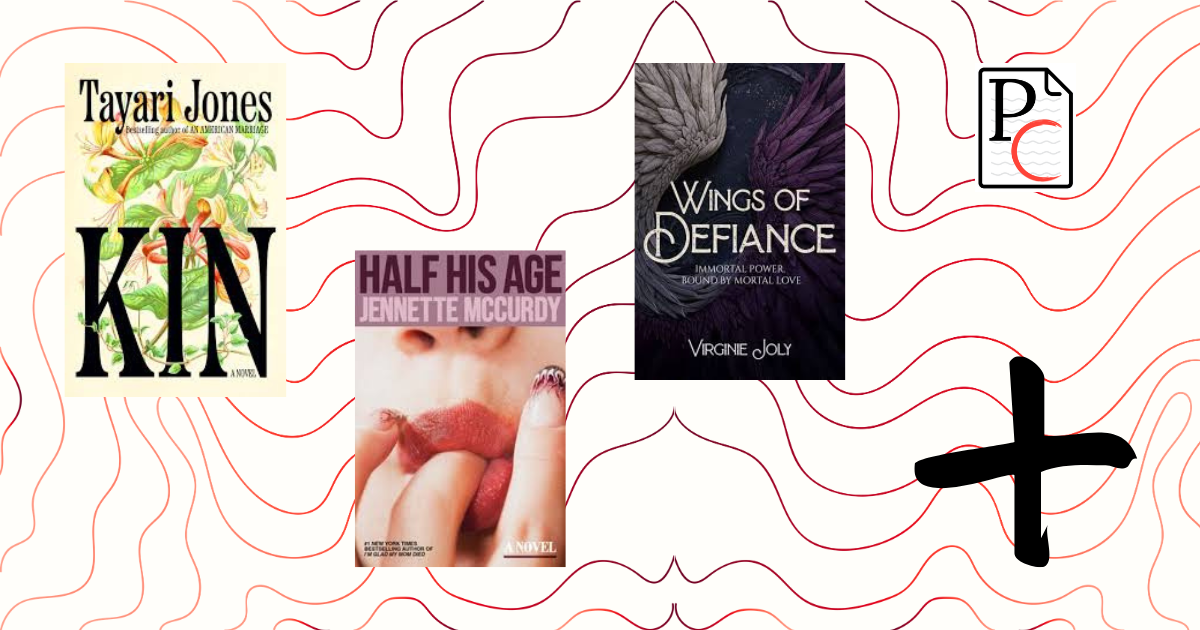
This month’s What to Read listicle features early 2026 fiction releases by Tayari Jones, Jennette McCurdy, and Virginie Joly, as well as two upcoming memoirs with spiritual themes that I edited.
Each has something valuable to offer the reader.
I also mention a couple of books I hope to review next month, and I offer some insight into how I dealt differently with the hybrid formats of the books I edited in March. I use Dear Memory by Victoria Chang as a guiding light.
Kin by Tayari Jones

Kin is Tayari Jones’s fifth novel, the first successor after An American Marriage. This novel’s first layer of plot covers lifelong female friendships, particularly the relationship between Vernice and Annie, both motherless but for different reasons. For Vernice, or Niecy, her mother passed away, killed by her father. For Annie, her mother is still very much alive and out there somewhere. Occasionally, she visits their small town in Honeysuckle, Louisiana, but never stops by to see her. Vernice envies Annie whose mother is still alive, and Annie envies Niecy whose mother did not abandon her by choice. Their views on their respective losses and traumas lead them down different paths. The novel is a divergent odyssey with rich characters who feel real enough to touch. Each character has their own distinct voice, motivations, and even catch phrases.
Our two main characters are marked by their grief that circumstances stole the maternal love they see reflected in others more fortunate, and in their own community, but cannot touch. The ache is tangible.
I find myself thinking about this book and its heartbreaking ending at stoplights. I finished it weeks ago, and it’s still with me.
If you want to be hurt and soothed at the same time, pick up this book.
Half His Age: A Novel by Jennette McCurdy

Half His Age is Jennette McCurdy’s second book but first novel. When I added this book to my to-read list, I erroneously believed it was a follow-up memoir to I’m Glad My Mom Died, an expansion to the inherent grooming nature of Hollywood, which preys on child actors, or a response to HBO’s Quiet on Set. Instead, the book follows a 17-year-old girl who pursues a relationship with her creative writing teacher.
I felt so affected by this work that I wrote a personal-essay-as-literary-criticism piece about it. In the hopes of getting this piece placed somewhere, I won’t say much here. (Most publishers won’t accept previously published work.)
Once the piece has been published somewhere (manifest!), I’ll share the link.
Until then, just know you will feel uncomfortable while reading this book (I certainly did!), and according to several interviews with Jennette McCurdy I read, that is the point.
Wings of Defiance by Virginie Joly

I read an advance reader copy through Reedsy Discovery, an epic fantasy novel called Wings of Defiance, the first installment in a new series. This breath of fresh air was the wind beneath my wings, especially after the disappointment of February’s ARC, The Not So Dead People.
Reading this, I felt like that clip of Gordon Ramsey, where he’s like:

Wings of Defiance renewed my faith in advance reader copies.
Here’s a quote from my review:
Wings of Defiance is not Christian fiction, and thank God—with all this heated passion, you might’ve gone to hell.
Virginie Joly handles Wings of Defiance with fortified prose. Complicated regulations surrounding archangel ascension, the consequences of a Draconian shapeshifting into a dragon while pregnant—Joly explains these concepts and more without losing the galloping pace of the plot. The twists and turns in the text feel divinely guided.
Wings of Defiance has two main characters: Uriel, one of seven archangels in Luneria, and Sestra, a Draconian hybrid who distrusts archangels as a result of long-term trauma. Joly uses Sestra’s hybrid powers as a metaphor for resilience. Adapting to trauma enables us to survive the harshest environments. Likewise, power loses purpose in the wake of threat, and the reader, through Sestra’s story, learns that lesson too. “We choose who we are,” the book reminds us, so guard yourself against “letting your wounds speak” for you.
Read my full review here. And follow me on Goodreads!
Next Up for Fiction
Next month, you can expect to read my thoughts on at least these two novels:
- Klara and the Sun by Kuzao Ishiguro: This is the same author of Never Let Me Go, which I have read twice. I actually just finished Klara and the Sun, and I liked it, but I need to chew on it for a bit longer before I can translate my thoughts.
- Alchemised by SenLinYu: This is Harry Potter fan fiction, originally called Manacled, that got picked up by a traditional publisher, and the girlies are living for this dark, DARK romantasy. The magic system arguably makes a lot more sense than the source material. I’m only on Chapter 6, but I’m enjoying it so far.
Books I Edited in March 2026
I had the absolute privilege of editing two memoirs with spiritual themes in March.
The Quiet Steps Are the Loudest by Susan Riley
Susan’s memoir begins with her acceptance of her own supernatural energy sensitivity. Ever since she was a little girl, she could see ghosts, and she felt lonely and afraid when her family didn’t believe her. This launch pad takes us to the self-love lessons of the book. The author guides the reader to accept who they are, to stand up for themselves, to ask, “What is this teaching me?” instead of “Why does this keep happening to me?”
Here’s an excerpt from my editor’s letter to Susan:
I loved your writing voice. Your voice is conversational but authoritative and powerful, which I think is exactly the voice this kind of book calls for. You perfectly balance personal exposition with universal lessons. (I loved learning about your life though—especially your energy sensitivity—and I hope that you write another book that delves more into those experiences!)
The stories and lessons came to me at exactly the right time. […] This book has helped me see the steps that I am taking now, the quiet, small ones, as evidence that I am building the life I want, right now. Even when the outcome still feels far away.
Susan is hosting her book launch party on August 8 (updated)! Purchase her book when it releases!
GILBEE STRONG by Gil Roden

This memoir covers how a father’s faith came after his son was in a terrible dirt bike accident that resulted in a traumatic brain injury. The story goes from tense shock to triumphant as Gilbee relearns how to talk and walk again.
Here’s an excerpt from my editor’s letter to Gil:
I found your memoir incredibly moving. Your imagery was lyrical and evocative. You naturally gravitated to action verbs over passive verbs most of the time. Your dialogue flowed well and sounded believable and human—which is not a skill many writers have. I teared up while reading the book several times, at parts I both did and didn’t expect. Each word drips with emotion.
I hope that this isn’t the only book you will write! You have a clear talent and a strong voice. I know other people would love to read your work.
Gil doesn’t have a launch date set yet, but rest assured, I’ll update y’all when the book is available for preorder.
June Update: GILBEE STRONG is available for purchase NOW.
An Update on Memoirs in Hybrid Formats
I’ve been sharing lately about how many of the manuscripts that come to me are written in a hybrid format, fluctuating between poetry and prose.
Both of the manuscripts I edited this month had this hybrid format!
I chose to overwrite the verse in The Quiet Steps Are the Loudest while keeping some of the verse in GILBEE STRONG, and here’s why:
In Susan’s memoir/self-help hybrid book, her use of verse was inconsistent—not just that its appearance was intermittent, but there also didn’t seem to be a purpose for the verse format when it arose. Her sentences were often punchy and short, though, with a voice all her own, so instead of Shift + Enter-ing, I simply Entered, letting powerful statements stand on their own, taking up space in their own paragraphs.
In Gil’s memoir, he used line breaks mostly to separate sentences from one another in a paragraph (as you might see in a LinkedIn post), but the line breaks became more frequent at highly emotional parts of his book.
Here’s another excerpt from Gil’s editor’s letter, to show how I worked with his prose/poetry memoir:
I used verse format heavily in the Prologue and Chapter 2 to capture your newly fragmented view of the world in the uncertainty after Gilbee’s accident. I trickled verse into the first chapter in foreshadowing moments, highlighting your hindsight perspective. I formatted epigraphs and the Acknowledgments section in verse.
In later chapters, I relied mostly on standard paragraph format because they were so dialogue heavy and technical that I wanted to prioritize clarity over poetry. That said, your lyrical writing will keep the reader connected to the emotional intensity of the story. Additionally, because your paragraphs are often so short, I think the natural format of the book will lend itself to what I believe you were going for with the line breaks. Even in the chapters led mostly by paragraph format, I included the occasional poem using your words. I did this when you included a particularly wise insight that read almost like a proverb, which I think works well with the theme of the memoir.
As part of my research on hybrid form memoirs, I am very slowly reading Dear Memory by Victoria Chang. I think Chang is the perfect person to study to better understand the relationship between prose and poetry because she has written several poetry collections, one young adult novel in verse, and now a collection of essays that are poetic in theme. In Dear Memory, Chang uses italics to indicate dialogue, a format often used in narrative poetry. She writes letters to past loved ones, to old friends, and to apostrophes like Silence, many of whom she addressed in her poetry collection Obit.
When I have the time (HA HA!), I will sit down and compare her letters to Silence to, if memory serves, her obituaries for Silence.
As always, stay tuned.
Want to read more of my long-form thoughts on books? Check out my Media Crit page.
Want to ask me to review your book? Page me.
Want to hire me to edit your memoir or novel? I’ll carve out time for you.
Leave a Reply